

In partnership with Camunda, we offer an expert delivery of process orchestration solutions, empowering organisations to connect people, systems, and AI into seamless, end-to-end workflows that are built to carry the most complex environments and workflows.
The challenge with automation and customer experience.
The use of disjointed automation and AI tools causes technical and organizational debt, with a diminishing return on investment, the result...
Broken end-to-end automation
Siloed automations that don’t integrate create broken end-to-end processes, disrupting customer journeys and damaging revenue and loyalty. Disconnected AI agents, automated tasks, and human oversight lead to inconsistency and trust issues that prevent transformation. Fragmented AI agents also increase operational overhead and slow down business agility.
Lack of understanding and trust
Broken automation eliminates process visibility, making it impossible to track metrics, identify where AI delivers value, or prove ROI. This breeds distrust in agentic AI—especially black-box agents lacking transparency and governance. Without visibility and control, leaders won’t deploy agents in core business processes, particularly in regulated industries.
Lack of flexibility and scalability
Without end-to-end process visibility, organisations can’t scale or evolve workflows. Updates become difficult because changes ripple across multiple systems. Monolithic automation platforms and some iPaaS solutions worsen this—their closed, tightly integrated architectures lock organizations in, limit deployment options, and hinder integration with other systems. This inflexibility slows time-to-market and stifles innovation.
Understanding Process Orchestration.
Processes are the algorithms that determine how an organization runs. They define how teams work together, how the organization works with partners and suppliers, and how it delivers value to its customers.
More and more, IT and business leaders are recognising that in order to deliver better customer experiences, keep up with competitors, streamline operations, and improve their bottom line, they must automate the processes that are core to their business.
This is the digital transformation imperative: Embrace automation today or go out of business tomorrow.
of organizations have seen increased business growth due to process automation over the past year
plan to increase their automation investment by 10% or more
of respondents said that automation initiatives cannot keep pace with the rate of change in their organisation
Process orchestration is a technology that coordinates the various moving parts of a business process, and sometimes even ties multiple processes together. Process orchestration helps organizations work with the people, systems, and devices they already have while achieving even the most ambitious goals around end-to-end process automation.
Process orchestration, task automation, and process automation are related, but they’re not the same.
- Task automation is the use of technology to automatically perform certain tasks without human intervention.
- Process orchestration is the coordination of the tasks that make up a process, both automated and manual.
- Process automation is a mix of process orchestration and task automation that automates a process, where the degree of automation can vary.
When to Consider Process Orchestration.
The processes that benefit most from orchestration are core business processes—the ones that build and sell an organisation’s products and services. However, any process that has these qualities can be improved through effective orchestration:

Endpoint diversity
The process involves many different process endpoints

Process complexity
The process’ logic is more complex than a simple sequence of steps
Why the need for enterprise-grade AI Agents to Support Process Orchestration?
There’s a gap between agentic promise and production reality…
Most organisations have piloted agents, RAG tools, and domain-specific copilots, yet struggle to scale beyond siloed, task-level use cases. The result: limited autonomy, brittle integrations, and low trust for mission-critical work.
Resilient orchestration that’s stateful, scalable, and fault-tolerant for long-running agents and processes
Composable integration that connects people, systems, and agents across business processes
Flexibility and reusability so process owners can dial agent autonomy up or down as needed
Guardrails and auditability that enforce compliance and eliminate black-box behavior
Operational visibility so you can monitor agent performance, costs, and outcomes
Enterprise agentic automation get significantly higher value from AI with a solution that provides the guardrails needed to trust in AI’s autonomy, enabling deployment across end-to-end and mission-critical business processes.
Agent development
Build enterprise-grade agents with guardrails so that they can solve complex problems with autonomy
Agent orchestration
Coordinate multiple agents and people together to achieve desired outcomes
Case and process automation
Deliver end-to-end automation for structured and semi-structured work
Our approach to agentic orchestration.
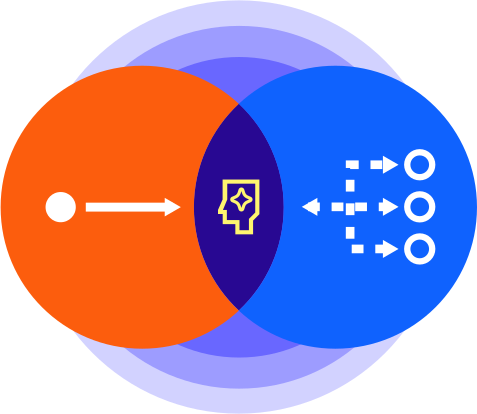
Camunda provides best-in-class process orchestration to serve as a foundation for agentic orchestration. Using Camunda, teams can embed AI agents directly into process models using BPMN, allowing agents to decide what happens next based on goals, context, and available tools. Teams can even mix-and-match Camunda agents with agents from other providers in the same process model. This creates processes that can adapt in real time without sacrificing the structure, governance, or auditability that BPMN provides.
Unlike platforms that bolt AI onto processes as isolated tasks, Camunda treats agents as first-class citizens of the process. This means that AI agents are executed by the same workflow engine as the rest of the process, with full visibility into their actions, inputs, and outcomes. Whether a process follows a predefined path or defers to an AI agent for decision-making, everything is executed within a shared orchestration environment.

Business Benefits
- Deliver faster, more consistent customer experiences
- Reduce operational costs and manual workload
- Enable AI-powered decision-making with transparency and control
- Increase process agility and scalability
- Maintain compliance and auditability across all workflows
Ideal Use Cases
- Customer onboarding and case management
- Mortgage and insurance claims processing
- Finance, HR, and procurement workflows
- Compliance, risk management, and regulatory processes
- AI-driven process automation and optimisation